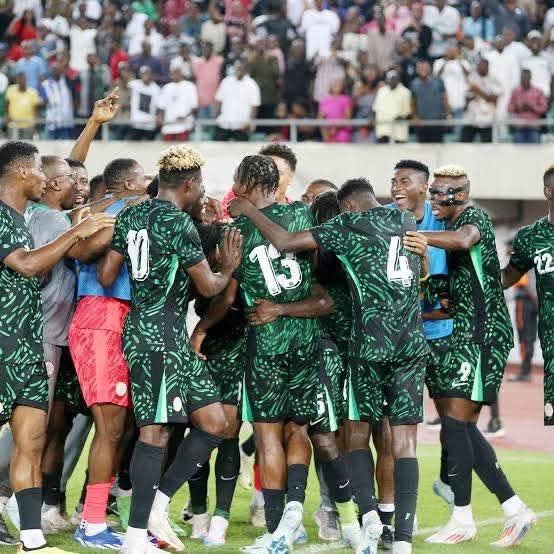
Super Eagles’ AFCON 2025 Campaign Hits Familiar Bonus Turbulence

The Super Eagles have frozen all operations—refusing to train or travel for their quarter-final game against Algeria until their unpaid bonuses are settled in full, as first reported by the BBC’s Oluwashina Okeleji, and confirmed by sportglitz.
Nigeria’s Super Eagles, fresh from a dominant win against Mozambique, are once again at a crossroads where off-field drama threatens on-field glory.
As the team prepares for a heavyweight quarter-final clash against Algeria, the squad has entered a state of standstill that feels like a haunting repetition of history.
Despite going unbeaten to reach the knockout stages, the players and coaching staff have made it clear that they will not train or travel to Marrakech this Thursday unless their financial grievances are addressed. The dispute involves unpaid win bonuses from four separate matches against Tanzania, Tunisia, Uganda, and Mozambique. This latest standoff highlights a strange and persistent ability within the Nigerian football administration to self-sabotage at the very moment the team looks poised for greatness.
This current crisis is a direct echo of the friction that derailed the team’s path to the 2026 FIFA World Cup. In November 2025, during the final stages of the qualifiers, the Super Eagles engaged in a standoff ahead of their crucial game against DR Congo.
The squad boycotted training sessions in Rabat, Morocco, demanding that their winning bonuses be increased to $15,000 per match to match the scales of rival African nations. The Nigeria Football Federation countered with an offer of $10,000, leading to a stalemate that distracted the players during the most critical week of their campaign. The lack of focus was ultimately reflected on the pitch, where Nigeria played out a 1-1 draw before falling 4-3 in a penalty shootout. The loss ended their World Cup dreams.
The most significant casualty of that administrative chaos was the retirement of captain William Troost-Ekong. On December 4, 2025, the veteran defender officially called time on his international career, citing a mix of physical exhaustion and professional frustration.
As the primary leader of the squad, Troost-Ekong had spent years acting as the middleman between the players and the federation during bonus rows. In his departure statement, he was vocal about the mental toll of constantly fighting for basic entitlements rather than focusing purely on football. He noted that while his body was feeling the effects of a major hamstring surgery, the lack of an elite, organized environment made the decision to step away much easier. Having been left on the bench during the heartbreaking loss to DR Congo, he chose to walk away rather than continue navigating a system that he believed was holding the players back.
The team is currently performing at an elite level, yet they find themselves once again begging for promises to be kept. The irony is that the officials made explicit guarantees to the coaching staff and players before the tournament began, yet the cycle of unpaid allowances has returned to haunt the camp. If the NFF fails to resolve this situation by the Thursday deadline, the Super Eagles may find that their greatest obstacle to a fourth African title is not the strength of their opponents, but the internal failures of their own management.