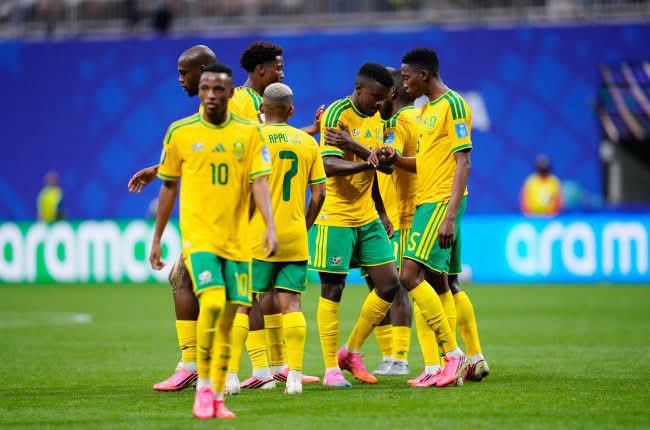
Broos Faces Selection Dilemma as Bafana Prepare for Canada Showdown

Success often creates its own problems. After guiding South Africa to their first-ever FIFA World Cup knockout stage appearance, Hugo Broos must now solve the Canada puzzle. Whether the return of midfield lynchpin Teboho Mokoena strengthens the side, or inadvertently disrupts the formula that propelled them past the group stage, is the ultimate question weighing on the gaffer’s wisdom-filled grey hair.
As the Bafana Bafana prepare for their Round of 32 clash against Canada in Los Angeles this night, head coach Hugo Broos finds himself confronted with the kind of selection dilemma every manager craves—and fears.
After guiding South Africa beyond the group stage for the first time ever, Broos must now solve a tactical puzzle that could ultimately determine whether Bafana’s World Cup journey extends into the last 16 or comes to an end on American soil.
The biggest talking point ahead of the knockout clash is the return of midfield orchestrator Teboho Mokoena following suspension.
On paper, the equation is: South Africa’s most influential midfielder returns to the starting lineup. In reality, however, Mokoena’s availability creates a selection headache.
Mokoena reminded everyone of his importance with his nerveless late penalty against the Czech Republic, a moment that arguably kept South Africa’s World Cup campaign alive. However, his return disrupts a midfield unit that excelled in his absence during Bafana Bafana’s crucial 1-0 victory over South Korea.
In that decisive group-stage encounter, Sphephelo Sithole produced one of his finest performances in national colours, combining relentless defensive work with impressive ball progression.
Dropping Sithole or Thalente Mbatha after such a display would feel unjust. Equally, leaving out Mokoena is virtually unthinkable.
The real danger for Broos lies in attempting to accommodate too many central midfielders simultaneously. Deploying Mokoena, Sithole and Mbatha as a midfield trio could push South Africa into an overly conservative approach—one that risks surrendering initiative to Jesse Marsch’s aggressively pressing Canadian side. That would amount to showing Canada too much respect.
This encounter will be decided by tactical execution a —factor that only increase the pressure on Broos to find the perfect balance.
If the midfield selection presents one dilemma, South Africa’s attacking structure presents another. Broos must decide which offensive identity gives Bafana Bafana the best chance of exploiting Canada’s high-energy pressing system. One option is to embrace unpredictability. The False Nine experiment
Starting Relebohile Mofokeng as a fluid false nine would allow South Africa to prioritize movement, technical combinations and positional rotations. Such an approach could lure Canada’s centre-backs out of position and create spaces for runners from midfield and the wings. It would also represent South Africa’s boldest tactical statement of the tournament.
Alternatively, Broos could rely on a more conventional focal point. The options are plentiful: the mobility and pressing intensity of Lyle Foster, Iqraam Rayners, or the physical aerial presence offered by Evidence Makgopa. In knockout football, experience often favours pragmatism over experimentation.
A closer examination of South Africa’s group-stage performances provides valuable insight into the tactical direction Broos may choose.
Against Mexico, the Belgian tactician approached Conservatively with à 4-2-3-1, with Foster isolated and Mokoena operating deep . It ended in a 2-0 defeat.
Against Czechia Broos balanced 4-2-3-1, granting Mokoena greater attacking freedom Draw and it paid off with a share of the spoils (1-1).
In the final group game against South Korea, Bafana Bafana came in with high-intensity (4-3-3/4-2-3-1) hybrid, featuring aggressive pressing and direct transitions with led to a 1-0 victory.
Broos cannot afford to repeat the passive approach employed against Mexico. Equally, he cannot simply replicate the South Korea formula because Mokoena’s return changes the equation entirely. The most likely solution is a balanced system that transitions between a 4-2-3-1 and a 4-3-3.
Such a setup would pair Sithole and Mokoena at the base of midfield, allowing Mokoena the freedom to dictate tempo while preserving the defensive security and energy that Sithole demonstrated against South Korea.
Further forward, Broos’ historical preference for physical security in tournament football suggests that Foster may once again get the nod as the central striker. His mobility and ability to press from the front could prove crucial against Canada’s athletic backline, while Maseko and Appollis exploit spaces left behind by Canada’s press.
The group stage fun and games is well over with. In the knockout, margins are measured in moments, that distinction could determine whether South Africa’s American dream survives another round.