From Colony to Contender: Senegal’s Date With History Against France

As Senegal prepare to take on France today at the 2026 FIFA World Cup, the fixture will be one of the tournament’s most emotionally charged encounters. While every World Cup match carries sporting significance, few can match the layers of history, culture, migration and symbolism attached to a meeting between these two nations.
For over three centuries, the destinies of France and Senegal have been intertwined. Their relationship has produced remarkable cultural exchanges, economic ties and sporting partnerships, but it has also been marked by the unequal realities of colonialism. As the Lions of Teranga prepare to take on Les Bleus, the match offers an opportunity to reflect on a relationship that has evolved from colonial domination to modern partnership, and from dependency to growing equality.
The Beginning of French Rule in Senegal
France’s connection with Senegal dates back to the seventeenth century. French merchants established trading posts along the Senegalese coast, particularly on Gorée Island and in Saint-Louis, which would become one of France’s important colonial centers in West Africa.
By the nineteenth century, Senegal had become the cornerstone of French expansion in West Africa. Dakar eventually emerged as the capital of French West Africa, the vast colonial federation that included present-day Mali, Burkina Faso, Niger, Benin, Guinea, Mauritania and Côte d’Ivoire.
French administrators viewed Senegal as the showcase of their colonial project. The territory became a laboratory for France’s policy of “assimilation,” which sought to create colonial subjects who adopted French language, culture and institutions.
The legacy of that era remains visible today. French is still Senegal’s official language and the principal language of government, education and diplomacy. Millions of Senegalese speak French daily alongside national languages such as Wolof, Pulaar, Serer and Diola.
Even the currency carries traces of the colonial past. Senegal uses the CFA franc, first introduced by France in 1945. Though the currency has evolved significantly since independence and is now managed by the Central Bank of West African States, its origins remain tied to France and continue to fuel debates about economic sovereignty across the region.
Independence Without Separation
Senegal gained independence from France in 1960 under the leadership of President Léopold Sédar Senghor, an influential intellectual and statesmen.
Unlike many former colonies whose post-independence relations with their colonial rulers became hostile, Senegal maintained close ties with France. Senghor himself was influenced by French literature and culture while simultaneously championing African identity through the Négritude movement.
The result was a unique relationship. Independence brought political freedom, but educational, cultural and economic links remained strong.
France continued to be Senegal’s principal European partner. Thousands of Senegalese students attended French universities. Businesses from both countries invested across sectors ranging from telecommunications to banking. Diplomatic cooperation remained robust, while military and development partnerships endured long after independence.
This relationship produced a reality in which many Senegalese grew up consuming French media, studying French literature and following French football while simultaneously embracing their own national identity.
The Senegalese Community in France
Perhaps nowhere is the connection between the two countries more visible than in France itself.
Today, France is home to one of the largest Senegalese diasporas in the world. Estimates generally place the number of people of Senegalese origin between 200,000 and 300,000.
The community has become deeply integrated into French society while maintaining strong links with Senegal. Remittances sent home by Senegalese workers in France contribute significantly to the Senegalese economy. Family networks stretch across both countries, creating a continuous flow of ideas, culture and people.
Walk through neighborhoods in Paris, Marseille, Lyon or Bordeaux and the influence of Senegal becomes immediately apparent through restaurants, fashion, music and community organizations.
For many families, France and Senegal are not separate worlds but two parts of the same lived experience.
The cultural exchange between the two nations has transformed France itself. French music, especially hip-hop, has been profoundly shaped by artists of African heritage, including many with Senegalese roots.
Booba, a commercially successful rapper in French history, was born in France to a Senegalese father. His influence on French rap is difficult to overstate, with a career spanning more than two decades.
Other prominent artists of Senegalese descent include Mokobé, founder of the influential rap group 113, and singer-songwriter Ayo, whose family roots extend to West Africa.
Beyond music, Senegalese influence is visible in French literature, cinema, fashion and sport. The relationship has become a two-way exchange rather than a one-sided inheritance from colonial times.
France’s Reliance on Senegalese Football Talent
Football provides perhaps the most fascinating example of how deeply connected the two nations remain. Over the years, French clubs have viewed Senegal as one of Africa’s richest sources of talent.
The most successful example is the partnership between FC Metz and Dakar-based Génération Foot. Established in 2003, the collaboration revolutionized talent development in West Africa.
The academy has produced an astonishing list of stars, including Sadio Mané, Ismaïla Sarr, Habib Diallo, Pape Matar Sarr, Lamine Camara and many others.
The pathway became so successful that scouts across Europe began paying closer attention to Senegal. French football benefited enormously, gaining access to elite prospects before many rival leagues.
Metz is not alone. Clubs such as Strasbourg, Sochaux, Rennes, Monaco and Marseille have all maintained strong scouting networks in Senegal over the years.
French football has helped develop generations of Senegalese players, but the relationship has also benefited France, which has consistently drawn on Senegal’s extraordinary footballing talent.
Many members of Senegal’s golden generation were developed within the French football ecosystem. Sadio Mané played for Metz before becoming one of Africa’s greatest footballers. Kalidou Koulibaly was born in France. Idrissa Gana Gueye built part of his career in Ligue 1. Édouard Mendy played extensively in France before reaching the Premier League.
Numerous Senegalese internationals either hold dual nationality, were born in France or developed within French academies. The connection is so deep that many players lining up for Senegal will have spent years living, studying or competing in France.
Current Senegal coach Pape Thiaw embodies these links. As a player, Thiaw spent the majority of his professional career in France. He represented clubs including Saint-Étienne, Strasbourg, Créteil and Metz. His football education was largely shaped within the French system. The tactical and professional standards he encountered there helped mould the coach who now leads Senegal on the world stage.
In many ways, Thiaw represents the modern relationship between the two countries: a Senegalese leader whose development was influenced by French institutions but whose ultimate mission is to bring success to his homeland.
From Colonial Subjects to World Cup Giant-Killers
No discussion of France and Senegal can ignore the events of June 12, 2002. Few expected debutants Senegal to trouble reigning world champions France in the opening match of the World Cup. But Papa Bouba Diop’s famous goal delivered a 1-0 victory.
The result shocked the football world and remains one of the great upsets in World Cup history. For many Africans, the victory carried significance beyond sport. The symbolism was impossible to ignore. A former French colony had defeated the reigning world champions and former colonial power on football’s biggest stage.
While the players themselves focused on the sporting achievement, millions interpreted the result as a powerful statement about changing global realities.
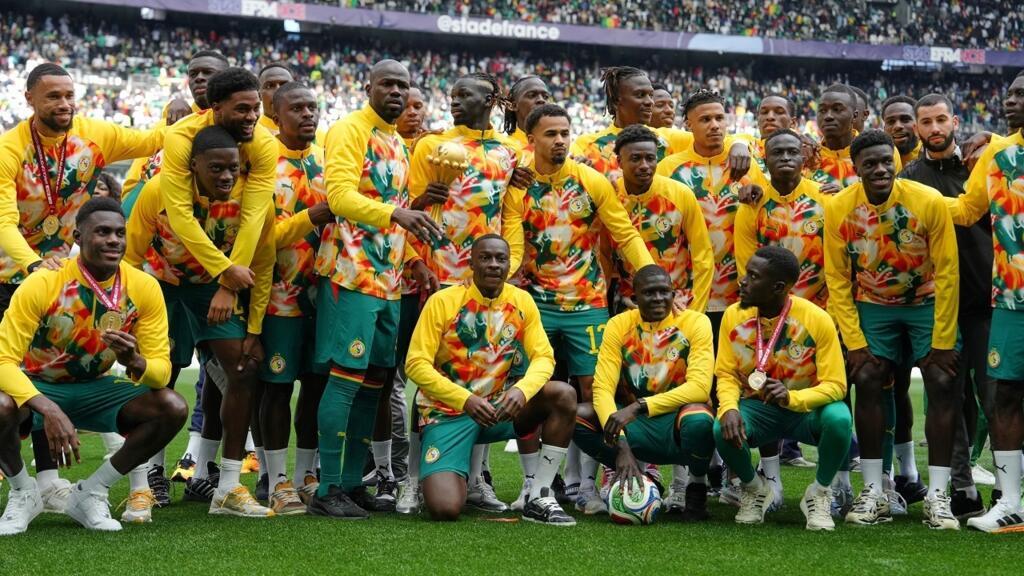
Twenty-four years later, Senegal reached another milestone by winning the 2025 Africa Cup of Nations – despite the CAF appeals board ruling, to hand Morocco the trophy, Senegal persisted with celebrations. The celebrations extended beyond Dakar. Thousands of Senegalese supporters gathered in a packed Stade de France for celebrations in a game played against Peru. The scenes demonstrated how Senegal’s victories resonate deeply within France itself.
Few national teams enjoy such passionate support both at home and inside their former colonial power.
A Match About Equality
The France-Senegal relationship today is far more balanced than it was years ago. France remains a global power. Senegal is a developing nation. Yet on the football pitch, those differences matter less than they once did. Senegal are no longer outsiders seeking validation. They are African giants, World Cup regulars and producers of world-class talent. Their players compete in Europe’s biggest leagues. Their football culture commands international respect.
A victory over France in New Jersey would not erase colonial history, nor would it settle centuries of complex relations. What it would do is reinforce a message that modern Senegal has been sending for years: that it no longer stands in the shadow of its former colonial ruler.
For many Senegalese supporters, defeating France would symbolize the breaking of psychological barriers that survived long after political independence. It would represent another step away from old notions of superiority and inferiority that colonial systems were built upon. The story of both countries is now a one of migration, cultural exchange, shared language, football partnerships and mutual influence. History echoes whenever the two nations meet. That is why this World Cup clash feels different.
And if Senegal emerge victorious, the result will be celebrated as another chapter in a national journey from colonial subject to confident global competitor – a nation determined to stand as an equal on every stage, including the biggest one of all.