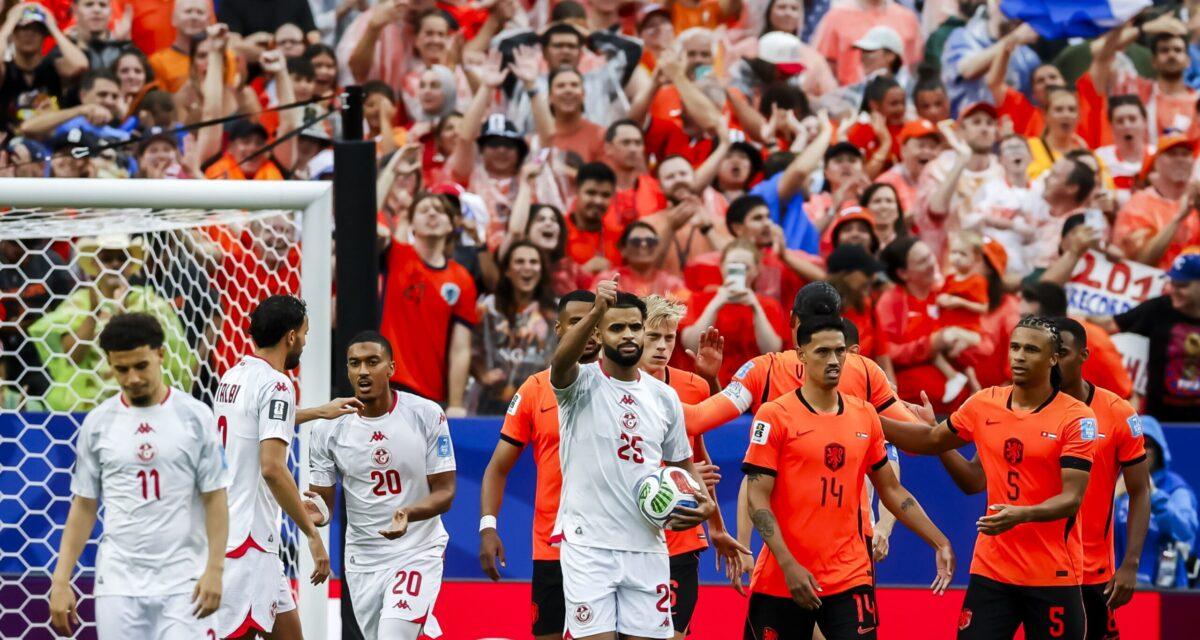
Tunisia’s Only World Cup Fight Came in the Dugout

- Tunisia’s Bench Showed More Fight Than the Players
When referee Yael Falcón Pérez reached into his pocket to caution Wahbi Khazri against Sweden, the yellow card perfectly captured a bigger picture: Tunisia’s World Cup campaign was not limited to eleven exhausted, energy-sapped men on the pitch. If anything, the bench looked far more alive.
Khazri, once the face of Tunisia’s attack and now serving as one of the Eagles of Carthage’s video analysts, could no longer contain his frustration when the World Cup was on its mark (opening day).
While players drifted through a difficult opener, the former captain argued from the touchline and earned a yellow card of his own.
Across three group matches, the Eagles looked devoid of belief. Coaches, analysts and support staff got increasingly frustrated on the sidelines, while many of the players seemed to accept their fate long before the final whistle. For a nation making its seventh World Cup appearance, and one that has long earned respect for its resilience, the sight was unsettling.
Khazri understands better than most what representing Tunisia demands. His 25 international goals make him the country’s second-highest scorer of all time, and among them is the winner against two-time world champions France at Qatar 2022. That strike allowed Tunisia to leave the tournament with their heads held high despite missing out on the knockout rounds. Four years later, that spirit vanished.
From Qatar’s Promise to Decline
There was genuine optimism after Qatar. Tunisia had beaten the 2018 champions, competed admirably throughout the tournament and appeared to possess a generation capable of carrying the national team forward. Instead, 2026 has become the bleakest World Cup chapter in the country’s history.
Tunisia scored only twice while conceding 12 goals, ending the tournament with a goal difference of minus ten. It was the poorest defensive record of any nation at this World Cup and comfortably the worst World Cup performance they have ever conjured.
The numbers also place Tunisia among the weakest teams in World Cup history. Only a handful of nations have recorded inferior goal differences, including Zaire; present day Congo in 1974 (-14), Haiti in 1974 (-12), El Salvador in 1982 (-12) and North Korea in 2010 (-11). Those comparisons, though, deserve context.
Most of those teams competed during an era when African, Caribbean and Asian nations had limited international exposure, fewer professionals and far less structured player development. Tunisia’s downfall has arrived in a completely different landscape.
The Afternoon Ayari Tore Tunisia Apart
No match illustrated Tunisia’s suffering more clearly than the opening defeat to Sweden. Yasin Ayari, born to a Tunisian father but representing Sweden, delivered a masterclass. The Brighton midfielder struck twice and tormented Tunisia throughout as Sweden cruised to a commanding 5-2 victory.
Ayari refused to celebrate against the land of his father. After each goal, he simply raised his hands in apology, acknowledging his family roots. It was a gesture of respect that did little to ease Tunisia’s embarrassment.
A Federation That Lost Patience
Within hours of the defeat, reports emerged that several members of the Tunisian Football Federation executive committee were prepared to resign unless head coach Sabri Lamouchi was dismissed. The federation granted their wish. Lamouchi became the first and only coach sacked during the 2026 FIFA World Cup. Tunisia turned to Hervé Renard, hoping his experience could restore belief before the remaining group matches.
Renard arrived with a fine résumé. He remains the only coach to win the Africa Cup of Nations with two different countries, triumphing with Zambia in 2012 before repeating the feat with Côte d’Ivoire three years later. On the global stage, he masterminded Saudi Arabia’s stunning comeback victory over eventual champions Argentina at the 2022 World Cup. His appointment reflected equal measures of ambition and desperation.
Renard’s Rallying Cry Fell on Empty Hearts
Renard wasted little time delivering his message. “Qualification was no longer the priority,” he reminded his players. Their task was to restore Tunisia’s honour, compete with courage and give supporters a team worthy of the shirt.
It was the type of speech that has defined much of the Frenchman’s career. This time, inspiration alone proved insufficient.
Japan hammered Tunisia 4-0 on matchday two of group F, in another one-sided contest. The players looked exhausted physically and mentally, while Renard admitted afterwards that his team had simply been second best. Watching from the technical area, a coach renowned for his passion could only look on in frustration.
It was difficult not to compare this squad with Renard’s Saudi Arabia team from four years earlier. In truth, that Saudi side was hardly generations ahead of this Tunisian squad in terms of individual talent. What made the difference was, playing with heart.
Hannibal’s Warning Became Reality
The warning signs had appeared long before Tunisia arrived in North America. Following the country’s elimination from the 2025 Africa Cup of Nations, Hannibal Mejbri admitted Tunisia had let its supporters down. He argued that questions needed answering if the nation hoped to return among Africa’s elite. His words proved prophetic.
For Hannibal himself, the contrast between his two World Cups could hardly have been greater. As a teenager in Qatar, he embodied Tunisia’s future. In 2026, despite registering two assists – for both of his team’s goals, he found himself trapped in a side that never developed cohesion.
Coaching Upheaval Is Nothing New
Lamouchi’s dismissal surprised outsiders, but within Tunisian football it followed a familiar pattern. The federation has long developed a reputation for acting swiftly after disappointing tournaments. In 1994, Youssef Zouaoui lost his job following an opening AFCON defeat to Mali.
Personnel changes also followed after the 2025 Africa Cup of Nations knockout exit. Such instability rarely allows long-term planning to take root. Every disappointing tournament seems to trigger another rebuild.
Should Tunisia Have Been There at All?
Perhaps the truth is that Tunisia, currently ranked 54th by FIFA, was fortunate to qualify in the first place. On sporting merit, Equatorial Guinea appeared poised to finish top of their qualifying group. FIFA later deducted six points after the team fielded an “ineligible” Emilio Nsue in two qualification matches, reshaping the standings. Tunisia returned to first place and secured automatic qualification. Without FIFA’s ruling, the Eagles may never have reached the tournament.
Strong Clubs, Stagnant National Team
Ironically, Tunisia remains a continental force at club level. Espérance de Tunis, Étoile du Sahel, Club Africain and CS Sfaxien have consistently challenged deep into CAF interclub competitions, but that success has failed to translate to the national side in recent years.
Seven players were selected from their domestic league, one of Africa’s highest totals at this World Cup. That alone cannot explain the team’s struggles. Egypt and South Africa have relied heavily on home-based players during this tournament, yet both remain firmly in contention for a deep tournament run.
The issue, therefore, extends beyond the domestic league. It concerns player development, building a team capable of competing with the world’s strongest nations.
Time for Honest Reflection
The arguments inside Tunisia’s technical area showed that some within the camp still cared enough to protest. Unfortunately, the football rarely reflected that same determination. Whether responsibility rests with the federation, the coaching staff or the players, Tunisia cannot dismiss this as merely a disappointing tournament. Their heaviest World Cup defeat, worst defensive record and one of the poorest campaigns in the competition’s history demand far deeper examination.
The PAMOJA Africa Cup of Nations qualifiers later this year offer Tunisia an immediate opportunity to begin again. The nation has lifted Africa’s biggest prize only once, back in 2004. If the Eagles are to prevent another collapse of this scale, they must first confront the reflection staring back at them.