Passport Players: Morocco Is Winning the Battle Africa Kept Losing

Watch them belt out “La Marseillaise” with fierce passion. From keeper to skipper, they have earned every right to represent France—even as fans across Africa point to their TV screens, claiming these players as their own. But Morocco seemingly cracked the code with Ayoub Bouaddi. Now, four years after their World Cup ousting in Qatar, the Atlas Lions are ready to avenge that French defeat.
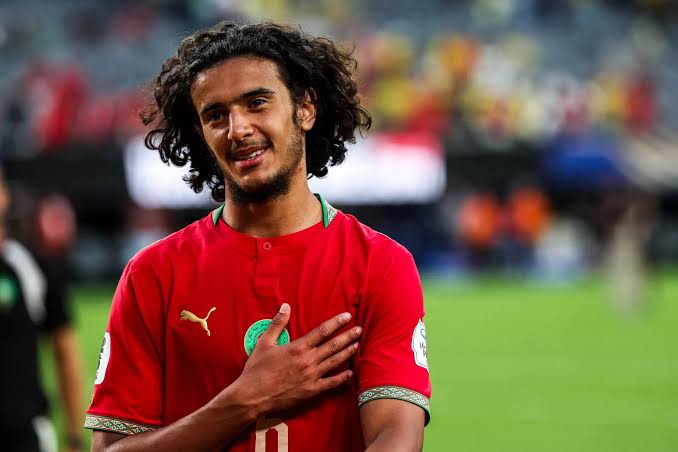
Four years after Les Bleus ended Morocco’s fairytale World Cup run, the two nations meet again with a semi-final place at stake. This time, however, the story begins with 18-year-old Ayyoub Bouaddi, who chose Morocco over the country that raised him. In doing so, he became the latest face of a quiet revolution taking place across African football.
At some point, every top African football nation has lived through heartbreak. A gifted youngster with African roots emerges from one of Europe’s elite academies, dominates youth football and quickly becomes the subject of a tug-of-war between the country of his birth and the land of his parents. Supporters back home dare to dream, only for France to unveil another international call-up in the battle for these “passport players.”
That narrative is expected to gain slight balance especially when the Atlas Lions face France in tomorrow’s FIFA World Cup quarter-final at Boston Stadium. Perhaps the most compelling story belongs to a teenager who, until recently, seemed destined to become France’s next great midfielder.
Ayyoub Bouaddi’s decision to represent Morocco over France has become one of the significant dual-national victories by an African federation in recent years. Now fate has produced the perfect storyline. Just months after pledging his future to the Atlas Lions, he has the opportunity to show France what exactly they missed out on. As if that were not enough, Thursday’s encounter brings to the fore an unfinished business.
This is the first World Cup meeting between France and Morocco since the 2022 semi-final in Qatar, where Les Bleus ended the Atlas Lions’ run with a 2-0 victory. Morocco had become the first African nation to reach the last four of a World Cup, before falling one step short of the final.
The pain of that night has never completely disappeared. Four years later, Morocco returns with a greater belief and a player whose international allegiance represents a victory prolly before the whistle.
Born in Creil and developed entirely within the French football system, he progressed through every youth national team, captained France’s Under-21 side and was widely viewed as one of the country’s brightest midfield prospects. At Lille, he broke records as the club’s youngest-ever professional.
Everything about his career pointed towards the French. France viewed him as part of the country’s next generation.
However, the Royal Moroccan Football Federation had other ideas after Bouaddi was identified as a priority before his international future became a public debate. Federation officials maintained close contact with both the player and his family, presenting a solid sporting project.
When Bouaddi chose Morocco earlier this year, the decision sent shockwaves through French football. It was not the story of a player settling for his supposed “second option”. That success was the product of years of strategic planning that has transformed Morocco into successful recruiters of multiple dual-national footballers.
Prior to Bouaddi, Amine Harit was among the earliest high-profile examples. Having helped France win the UEFA European Under-19 Championship alongside Kylian Mbappé, Harit appeared destined to continue his international career with France. Instead, he committed to Morocco.
Captain Romain Saïss followed a different path but reflected the same philosophy. Born and raised in France, he developed through the French league system before embracing his Moroccan roots internationally. His leadership became central to Morocco’s 2022 World Cup story, just like fleet-footed winger, Sofiane Boufal.
It wasn’t a piece of cake convincing these players to play for the Atlas Lions. Over the years, many African federations entered the dual-national race too late, waiting until players had established themselves in European club football before making contact. By then, emotional ties had often been replaced by years of international football in European youth teams, making a switch incredibly difficult.
Morocco changed the equation. Rather than wait to become a back-up option, the federation identified these prospects in their teenage years, building relationships with players and their families while presenting a long-term sporting vision. The establishment of the Mohammed VI Football Academy, continued investment in youth development and the credibility earned from consistent success at major tournaments reinforced the message that representing Morocco was not only down to sentiments but equally, sporting decisions.
The run to the semi-finals of the 2022 World Cup has helped the course. That success changed perceptions. Ayoub Bouaddi belongs to a generation that has grown up watching Morocco go heads-on with the best.
France are arguably the greatest beneficiaries of Africa’s talent migration. Didier Deschamps’ squad is filled with players whose family roots stretch across the continent. Captain Kylian Mbappé has Cameroonian and Algerian heritage. He has a close bond with Aurélien Tchouaméni who originates from Cameroon too. Ibrahima Konaté, Jules Koundé, Bradley Barcola, Manu Koné, Michael Olise, William Saliba, Jean-Philippe Mateta among others trace their roots to Africa
The French have mastered the art of turning Africa’s vast talent pool into one of theirs. Morocco is leading the fight, Africa can follow or watch talents evaporate – with “had we known” thoughts running across centuries.