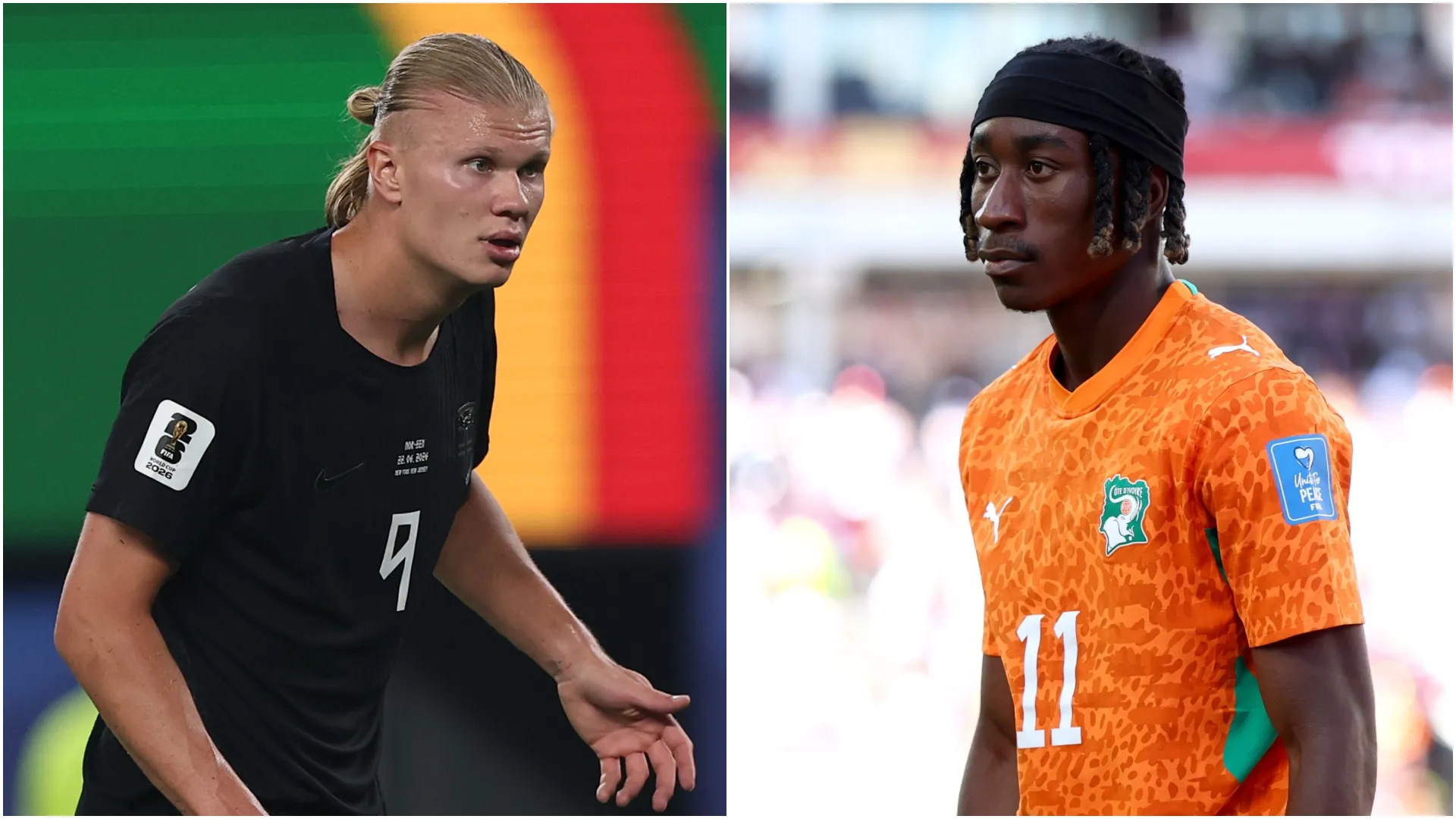
Red Bull Subplot Fueling Côte d’Ivoire vs. Norway

Since Erling Haaland departed RB Salzburg for Borussia Dortmund in 2020, the Red Bull GmbH group has continued to produce elite players but has still not uncovered another genuine global superstar. When Norway meets Côte d’Ivoire in the FIFA World Cup Round of 32 this evening, Haaland will face Yan Diomandé, the emerging Ivorian forward whose rapid rise has positioned him as perhaps the strongest candidate so far to inherit the mantle of Red Bull’s next transcendent talent—and potentially become the network’s next great African star after Sadio Mané.
On the surface, today’s clash in Arlington is a straightforward knockout contest: Norway’s golden generation, spearheaded by Erling Haaland, against an Ivorian side seeking to write another chapter in its football history. Beneath that sporting narrative, however, lies a subplot about one of modern football’s great talent factory and its significant role in shaping African football.
In many ways, this World Cup encounter represents a symbolic passing of the the torch. Haaland enters the match as the finished product of Red Bull’s developmental machine: a deadly striker and the face of Norway’s golden generation. Diomandé is an unfinished project, carrying the hopes of Côte d’Ivoire and the football empire.
Over the last decade, the Red Bull football group has refined a model that has altered the global football landscape. Rather than competing with Europe’s established powers for finished products, Red Bull built its reputation on identifying elite talent before the market fully recognized it, placing players in high-performance environments and moving them through a carefully constructed developmental pathway. No player embodies that philosophy better than Haaland.
When the Norwegian joined FC Red Bull Salzburg in 2019, he was regarded as a promising young forward. Within months, he had become one of the game’s most exciting talents, earning a move to Borussia Dortmund before establishing himself among football’s elite at Manchester City. His rise transformed him into the defining success story of the Red Bull model and set a benchmark that subsequent generations have struggled to match.
That is not to say Red Bull stopped producing elite talents. Since Haaland’s departure, the network has continued to develop outstanding footballers, including Dominik Szoboszlai and Benjamin Šeško. Nevertheless, none has combined statistical dominance, global appeal and cultural impact in the way Haaland did, leaving the organization still searching for its next universally recognized superstar.
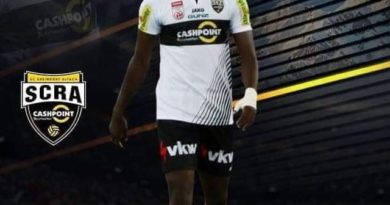
It is for this reason that the emergence of Yan Diomandé has generated such intrigue. At just 19, the Ivorian’s professional trajectory continues to accelerate, with only a nine-figure transfer fee expected to persuade RB Leipzig to consider his departure this summer.
Unlike many traditional African forwards developed within the Red Bull system, Diomandé combines explosive athleticism with elite ball-carrying ability. Comfortable operating across the front line, he has developed into a coveted young attacker, attracting attention beyond his native Côte d’Ivoire and reinforcing Red Bull’s belief that they may finally have found a player capable of following Haaland’s trajectory of global superstardom.
The numbers behind his breakthrough campaign help explain the growing excitement. In his debut Bundesliga season with RB Leipzig, Diomandé scored 12 goals and provided eight assists in 33 league appearances, directly contributing to 20 goals while helping Leipzig secure UEFA Champions League qualification. He also recorded a top speed of 36.3 km/h, underlining the explosive athleticism that has become his trademark. Across all competitions, the Ivorian teenager produced 15 goals and 11 assists in 42 appearances.
Individual recognition quickly followed. Diomandé was voted the Bundesliga Rookie of the the Season for 2025/26, succeeding Michael Olise.
Whether such comparisons ultimately prove justified remains to be seen. Nonetheless, the symbolism of their meeting on football’s biggest stage is difficult to ignore: one player representing the pinnacle of Red Bull’s success, the other carrying the possibility of becoming its next great story.
The remarkable aspect of the Conglomerate’s rise is that it has never relied solely on financial power. Instead, its success has been built on long-term planning.
Former RB Leipzig chief executive Oliver Mintzlaff was a principal architect of that strategy, helping transform what many initially dismissed as a marketing experiment into a successful sporting operation. The appointment of Jürgen Klopp as Head of Global Soccer in 2025 only reinforced those ambitions. Rather than coaching a single team, Klopp now oversees football strategy across the entire Red Bull network, helping shape sporting identity.
That network now spans several regions of the world. Alongside FC Red Bull Salzburg and RB Leipzig, clubs such as New York Red Bulls and Red Bull Bragantino operate within a shared framework built around aggressive recruitment, data-driven decision-making and player development. Nowhere has that strategy proven more effective than in Africa.
Over the years, the continent has become Red Bull’s nursery. Rather than waiting for players to become established stars, the network has identified prospects before they reach their peak, integrating them into developmental systems designed to maximize both sporting performance and market value.
The relationship has been particularly strong in West Africa, where academy structures such as the renowned Jean-Marc Guillou network have produced footballers suited to Red Bull’s style of play.
The list of African success stories is extensive. Sadio Mané remains one of the great African success stories. Before anchoring Liverpool’s celebrated front three, the Senegalese forward used Red Bull Salzburg as the launchpad for his rise to global stardom. More than a decade later, Yan Diomandé is now being viewed as the strongest candidate to inherit that mantle.
Naby Keïta emerged through Red Bull Salzburg before earning a high-profile move to Liverpool. Mali internationals Amadou Haidara and Diadie Samassékou followed similar pathways after developing through the Jean-Marc Guillou Academy in Bamako. Mohamed Camara and Sékou Koïta later reinforced Mali’s reputation within the structure.
Zambia’s celebrated generation also flourished within the system. Patson Daka and Enock Mwepu developed into high-level performers in Austria before moving to the English Premier League, while Cameroonian defender Jérôme Onguéné became a cornerstone of Salzburg’s domestic dominance, winning multiple league titles during his time at the club.
For Red Bull, the model has produced extraordinary sporting and financial returns. At the same time, its success exposes enduring inequalities: the institutions that develop talent rarely retain it long enough to build lasting sporting projects.
Economic realities frequently force African academies to sell their best players prior to complete development, creating a cycle in which institutions continually develop talent for others to ‘enjoy’. While the Red Bull system provides opportunities and pathways to elite football, critics argue that it also reflects broader structural imbalances within the global game.
Whether Diomandé eventually reaches Haaland’s level is impossible to predict. For Red Bull, this match represents a meeting between the player who validated an entire football philosophy and the young African forward who may ultimately redefine it for the next generation.