Spence, Partey, and the Fragile State of Africanity on the Global Stage

The final whistle in Boston should have brought an end to the conversation. Ghana had battled England to a goalless draw that strengthened the Black Stars’ chances of reaching the knockout rounds, while England’s hopes of advancing also received a boost ahead of their final group L match against Panama. However, as supporters dissected the implications on the standings, an image resurfaced.
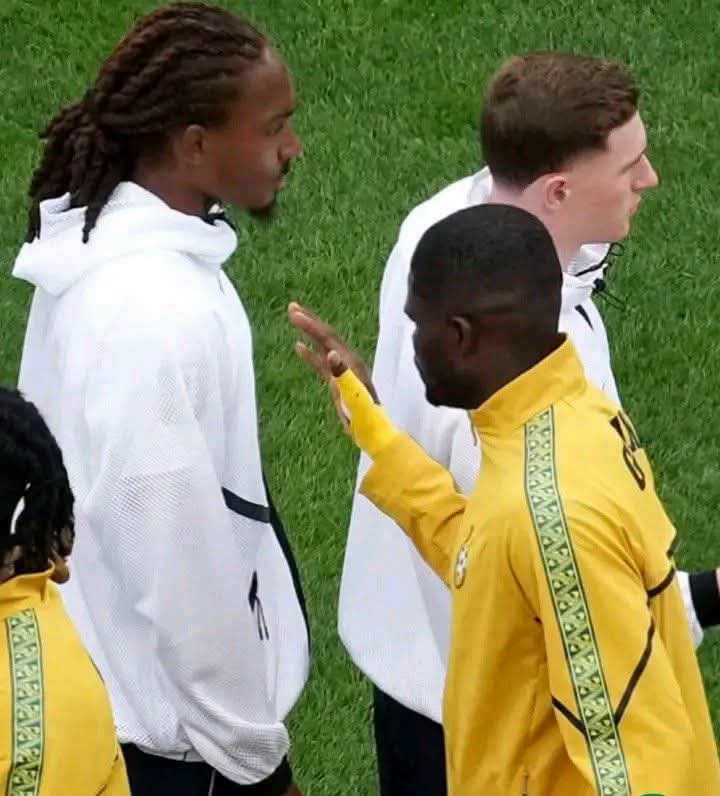
Prior to the game, among the players exchanging handshakes and embraces, England’s Djed Spence deliberately avoided Thomas Partey. Whether his personal decision was fair or not almost became secondary. What mattered was the reaction it generated, particularly among African football supporters who viewed the incident through a bigger picture, much larger than the pre-match handshake – ritual.
Partey arrived the Americas this summer carrying the expectations of his nation, though dealing with his own demons. The Ghanaian midfielder is facing eight criminal charges involving four women, including seven counts of rape and one count of sexual assault relating to alleged incidents between 2020 and 2022. He has pleaded not guilty to all charges and continues to maintain his innocence.
The legal proceedings have already had a direct impact on his tournament. Canada’s immigration regulations prevented him from entering the country for Ghana’s opening fixture against Panama, causing his absence for a match he should have started. Partey played Ghana’s subsequent fixture, which ended in a parity against England. For observers, the case has created understandable discomfort. Others argue that until a verdict is reached, Partey remains entitled to be treated as any other player.
What transformed the discussion was not merely the perception that Spence had chosen to “Ghost” Partey. It is who Spence is and what many expect him to represent.
Born and raised in London, Spence comes from a family whose roots go beyond England. His father is Jamaican, while his mother comes from Kenya. Spence belongs to a generation whose connection to Africa often exists alongside equally powerful ties to Britain and the wider Western world.
In the 19th and 20th centuries, Africans, whether on the continent or abroad, instinctively gravitated towards one another. Shared origins often created an immediate sense of familiarity, even among strangers. Today, that bond appears more complicated.
For decades, a sense of shared destiny bound Africans together. The philosophy commonly described as “Ubuntu” reflected a way of viewing society in which individual fortunes – were tied to the fortunes of the wider community. Success was rarely celebrated alone, and hardship did not belong to one person. The principle was simple: “I am because we are.”
During anti-colonial struggles, African nations frequently found common cause despite vast differences in geography, language and religion. In football, supporters transferred their loyalties to whichever African nation remained standing once their own country had been eliminated. A testament to that was Cameroon’s Olympic gold medal victory in 2000, shortly before the 2003 FIFA Confederations Cup final, where the entire continent chanted the sweet “O Cameroon, cradle of our fathers” anthem.
That instinct has become less visible in recent times. Migration has played a gargantuan role in reshaping identity, particularly among children born and raised abroad. Their parents may continue to view themselves primarily as Africans living in Europe or North America, but their children are exposed to a different reality. They attend local schools, build friendships within their immediate environment and absorb the values of the societies around them. Their sense of belonging naturally gravitates towards the countries they know best.
Africa remains part of their story, but often as heritage rather than daily experience. The emotional connection that once linked people across the continent can weaken when that connection is inherited rather than lived.
On paper, several members of the England squad possess direct links to Africa: Marc Guéhi, Ezri Konsa, Saka, Madueke, Eze and more have family roots linked to Africa. But when the discussion surrounding Partey emerged, no visible display of solidarity came from those who also trace their roots to the continent. They simply carried on with their business. That may have been entirely reasonable. Professional footballers are not obliged to involve themselves in every controversy. Even so, the scene is a stark contrast with what many older Africans might have expected from previous generations.
Interestingly, one of the players who appeared most comfortable greeting Partey before and after the match was Declan Rice, whose family background is Irish. The former Arsenal teammates exchanged smiles and acknowledged one another without apparent hesitation. It was an ordinary interaction, but one that stood out precisely because so much attention had already been placed on those who seemed reluctant to engage with the Ghanaian midfielder.
A question suddenly pops in the offing. If shared heritage no longer produces an instinctive sense of solidarity, what exactly has replaced it?
Part of the answer lies in the gradual rise of narrower identities. The generation that championed Pan-African ideals had common political struggles and a belief that progress for one African nation strengthened the position of all. Today’s environment is different. National identities have grown stronger, while digital platforms have amplified rivalries that once existed largely as harmless banter. Regional differences increasingly shape conversations. The language of unity remains popular, but its practical application often appears limited.
There is also a growing divide between Africans on the continent and those raised abroad. Many home-based Africans feel members of the diaspora no longer understand the realities of life on the continent. Conversely, many in the diaspora feel unfairly judged by standards they were never given the opportunity to learn. Language barriers, cultural differences and contrasting life experiences have created a distance that previous generations rarely encountered. What was once a broad sense of belonging is now fragmented. Perhaps the most troubling aspect of this divide is that it is not confined to relationships between Africans and their diaspora communities. It is becoming increasingly visible within Africa itself.
South Africa offers a notable example. Anti-immigrant sentiment directed towards fellow Africans has become a feature of public discourse. Movements and activists campaigning against foreign African migrants have gained attention, reflecting tensions that would have been difficult to imagine during the height of Pan-African movements. The fact that fellow black Africans can be viewed as competitors or outsiders speaks to a broader transformation in attitudes across parts of the continent.
Ironically, one of the few moments when a broad sense of African or black solidarity still appears is when racism enters the picture. When players face racial abuse in European stadiums or become targets of discrimination online, support often arrives quickly from across Africa and the diaspora. In those moments, shared identity suddenly regains its power. Differences in nationality, language and culture are pushed aside in response to a common threat.
Outside those situations, the old instinct to stand together often appears weaker than it once was.
Perhaps the discussion surrounding Spence and Partey has been overblown. It forced a closer look at how Africans see one another in an age defined by migration, competing identities and shifting loyalties. The concern is that the sense of shared responsibility once attached to Africanity no longer feels as instinctive as it once did.
Africanity was never about blind loyalty, neither was it about supporting someone regardless of their actions. It was about recognising a connection that transcended immediate differences and understanding that another African’s triumphs and struggles were not entirely separate from your own.
Today, that connection often seems strongest only when race becomes the issue. The moment racist abuse emerges, solidarity quickly returns. Before then, however, the bonds that once defined African unity appear fragile.
What transpired in Kansas City is therefore not only about Djed Spence or Thomas Partey. It is whether the idea of “I am because we are” still carries the same weight it once did.