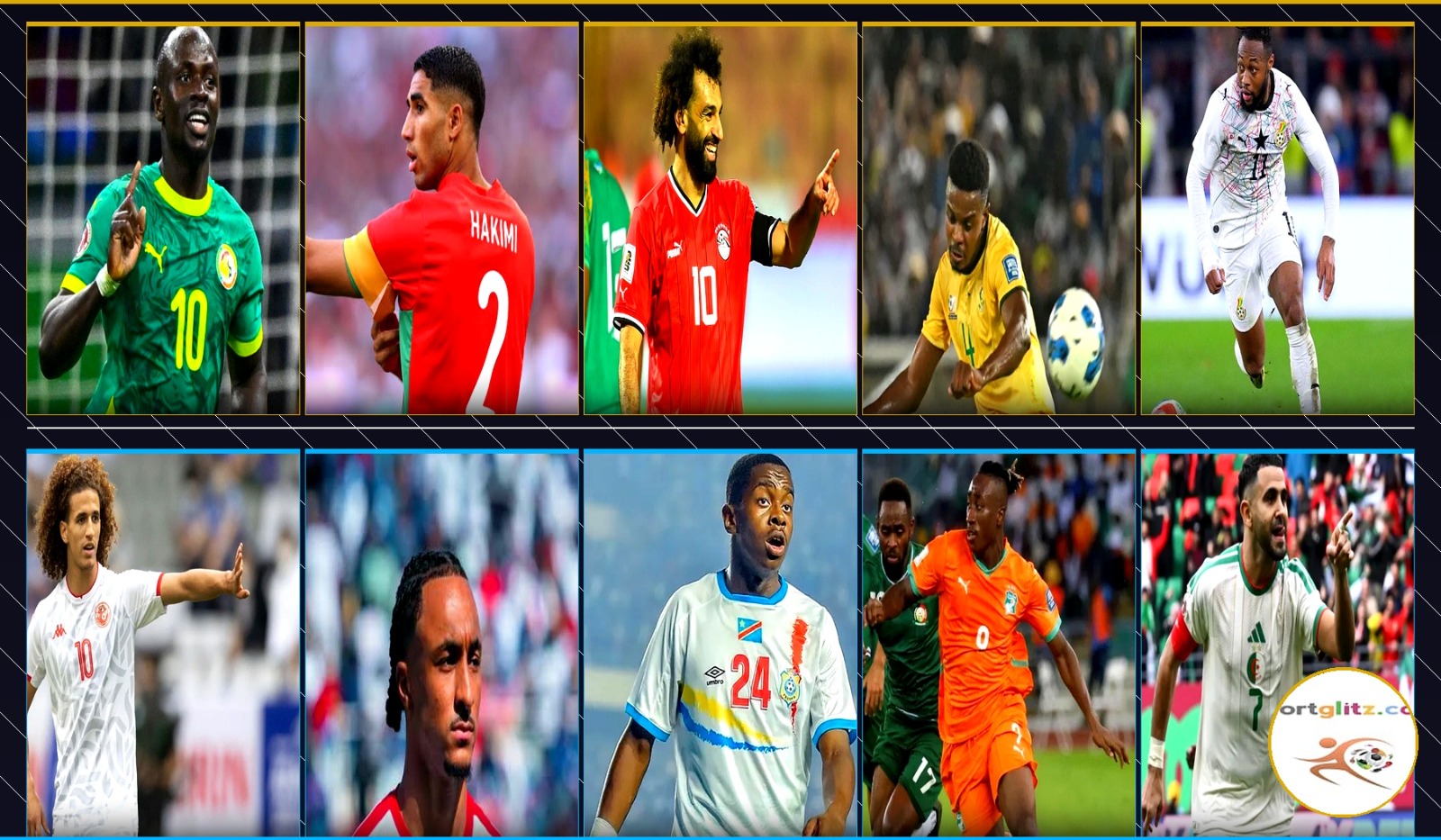
Africa’s Mavericks: The Stars Carrying a Continent’s World Cup Dreams

Africa heads to the World Cup armed with match-winners capable of turning games, inspiring nations and creating unforgettable moments.
Winning the World Cup remains football’s ultimate prize, but before a captain lifts the trophy, there are moments that become immortal. Few continents have produced more of these World Cup memories than Africa.
There was Asamoah Gyan’s brilliantly controlled volley against the United States in the Round of 16 at the 2010 FIFA World Cup, before breaking into his Azonto-inspired celebration. Two decades earlier, Roger Milla had captivated the world at Italia ’90, his exploits immortalised by the dance at the corner flag. At France ’98, Nigeria’s Sunday Oliseh stunned Spain with a thunderous long-range winner in a dramatic 3-2 victory, wheeling away in delight as his teammates swarmed around him. More recently, Youssef En-Nesyri’s towering header sent Portugal crashing out in the quarter-finals of the 2022 FIFA World Cup, triggering scenes of jubilation across Morocco and reverberating throughout the African continent.
From Egypt’s pioneering appearance as Africa’s first World Cup representative in 1934 to the present day, the continent has continued to supply football’s grandest tournament with stars capable of producing moments of brilliance.
As ten African nations prepare to compete in the Americas, the continent once again boasts an abundance of talent. Football remains a collective game, but every great team needs individuals capable of changing the course of a match in an instant. These are the mavericks—the players who carry the hopes of millions every time their names appear on the teamsheet.
INJURY-HIT BLACK STARS MUST SURVIVE
Ghana head into the 2026 FIFA World Cup without several players due to injury. Defenders Mohammed Salisu and Alexander Djiku are both unavailable, while the absence of Mohammed Kudus deprives the Black Stars of one of their most decisive attacking threats.
The 2010 World Cup quarter-finalists face a daunting Group L challenge against England, Croatia and Panama—a group that leaves little room for error or slow starts. Of all Africa’s representatives, Ghana arguably face one of the most difficult routes to the knockout stage. Yet, the Black Stars have built a reputation for thriving when expectations are at their lowest. That sounds like a story Carlos Quieroz mission.
Antoine Semenyo
Manchester City’s Antoine Semenyo arrives at the 2026 FIFA World Cup as Ghana’s primary attacking threat. Powerful and direct, Semenyo’s rise in the Premier League has established him as one of Africa’s formidable forwards. Since joining City in January, he has added greater tactical discipline and consistency to his game while retaining the explosive pace, strength and ball-carrying ability that define his style. With Mohammed Kudus absent, Semenyo is expected to shoulder much of Ghana’s attacking responsibility and serve as the focal point of the Black Stars’ offensive structure.
Abdul Fatawu Issahaku
Abdul Fatawu Issahaku remains one of Ghana’s most exciting wide options. At just 22 years old, Fatawu combines acceleration, agility and dribbling to destabilise defensive structures. His preference for cutting inside from the left flank and striking from distance makes him a constant threat. If fully fit, he offers Ghana the kind of unpredictability that can decide tight World Cup matches.
Thomas Partey
Thomas Partey remains the metronome of Ghana’s midfield despite ongoing debate surrounding his personal life off the pitch. His experience at the highest level with Atlético Madrid, Arsenal and Villarreal will be telling for the Black Stars. Partey’s role will be central to Ghana’s ability to compete against elite opposition in Group L. He currently sits just shy of 60 international caps, a milestone he is expected to reach before Ghana’s final group-stage match against Croatia.
Kwasi Sibo
Kwasi Sibo offers Ghana balance in midfield. His partnership with Thomas Partey could prove crucial against technically superior opposition. Sibo’s energy, positional awareness and work rate allow Ghana to remain compact, making him an important component of the Black Stars’ team.
BAFANA BAFANA’S RETURN TO THE BIG STAGE
South Africa return to the FIFA World Cup for the first time since hosting the tournament in 2010. Drawn into Group A alongside Mexico, South Korea and Czechia, Bafana Bafana enter the competition as underdogs—but not without reason to believe.
Head coach Hugo Broos has built a side difficult to breakdown. Here are some of the key players South Africa will rely on when the pressure mounts;
Ronwen Williams
Few African goalkeepers have risen in stature quite like Ronwen Williams.
Nicknamed the “penalty killer” for his remarkable record in shootouts, Williams has become the foundation of South Africa’s defensive stability. He is one of the continent’s most respected goalkeepers.
Fresh from captaining Mamelodi Sundowns to continental success in the CAF Champions League, Williams also formerly earned global recognition through his nomination for the Yashin Trophy in 2024, underlining his reputation among the world’s elite shot-stoppers. At 34, he remains capable of keeping his side alive in the most difficult moments.
Teboho Mokoena
Teboho Mokoena has developed into one of South Africa’s most complete midfielders. A former SuperSport United product, Mokoena brings balance, physical presence and technical quality to the centre of the pitch. His ability to hit long-range efforts makes him one of Bafana Bafana’s most influential outfield players heading into the tournament. He enters the World Cup at his peak.
Relebohile Mofokeng
One of South Africa’s most exciting young talents, Relebohile Mofokeng represents the future of the national team.
The Orlando Pirates attacker has emerged as a fearless dribbler, blessed with exceptional close control and explosive acceleration over short distances. Operating primarily from wide areas, he thrives in one-on-one situations and possesses a natural attacking instinct.
Still only 21 years old, Mofokeng’s inclusion in the World Cup squad underscores both his rapid development and South Africa’s willingness to trust youth on football’s biggest stage.
Given space, he has the ability to change games in an instant. He arrives at the tournament on the back of an impressive season with Orlando Pirates, registering 11 goals and nine assists across all competitions.
Themba Zwane
Veteran playmaker Themba Zwane brings experience to the South African squad. Returning from a long-term injury, the Mamelodi Sundowns midfielder remains Bafana Bafana’s most accomplished creative force, providing a connection between midfield and attack. His ability to operate in tight spaces and deliver defence-splitting passes makes him a unique asset in Hugo Broos’ system. Despite being 36, Zwane’s quality remains as sharp as ever.
Mbekezeli Mbokazi
Chicago Fire’s Mbekezeli Mbokazi has the pressure to transform his good club form to country. He is expected to be a locked-in starter at center-back for Hugo Broos’ squad. Mbokazi is highly proficient at playing out from the back, regularly maintaining high pass completion numbers. He has the ability to whip a 50-yard pass that lets the team out of pressure, and can immediately set his side on a counter after recovering possession, with his “educated” left foot.
THE PHARAOHS: SALAH AND THE WEIGHT OF EXPECTATION
Egypt arrive at the 2026 FIFA World Cup with expectations once again centred on Mohamed Salah—the nation’s greatest modern player. Drawn in Group G alongside Belgium, Iran and New Zealand, the Pharaohs will hope to finally progress beyond the group stage for the first time in their World Cup history. Salah, who has already scored two goals at World Cup finals, remains the focal point of Egypt’s attacking identity.
At international level, he has scored 67 goals for Egypt, leaving him just two shy of the all-time record of 69 held by current manager Hossam Hassan. If there is a stage to break that record, it is the world’s biggest one. His consistency over more than a decade has ensured Egypt remain competitive in major tournaments, even when collective performances fluctuate.
Omar Marmoush
Omar Marmoush offers Egypt a second attacking outlet. Quick, intelligent and capable of operating across the frontline. His movement between the lines and ability to attack space complements Salah’s perpetual influence on the right side. For Egypt, Marmoush represents both support and succession planning—a forward capable of easing the burden on their captain while still posing a direct goal threat. He is Salah’s side-kick at national team level.
Ahmed Sayed (Zizo)
Ahmed Sayed, popularly known as “Zizo,” remains one of Egypt’s most dominant domestic performers. The Al Ahly forward is renowned for his dribbling, close control and ability to create chances from wide positions. Even in a season where Al Ahly fell short of domestic dominance, Zizo’s individual quality remained unquestioned. His ability to shift between winger and attacking midfielder roles makes him a utility for coach the 7-time African champions.
Emam Ashour
Emam Ashour has become one of the most important midfielders in the Egyptian national setup. A knock sustained in May caused widespread concern across Egypt, a country with a population of over 110 million people, underlining his importance to both club and country. A dynamic and aggressive central midfielder, Ashour combines energy with technical ability, making him effective in both defensive and forward progression. He played a significant role in Egypt’s recent continental campaign, where they finished fourth at the 2025 Africa Cup of Nations, and continues to grow into a leadership role within the squad. Together with Zizo, Ashour provides Egypt with a strong domestic core to complement their European-based stars.
SENEGAL: CHASING HISTORY
Senegal touch down the 2026 FIFA World Cup with a clear ambition—to match or surpass their 2002 quarter-final run, according to coach Pape Thiaw. With a mixture of leaders and an emerging generation of high-level European-based performers, the Teranga Lions remain one of Africa’s most complete squads. Drawn into Group I alongside France, Norway and Iraq, Senegal face a challenging path set to test their resolve.
Sadio Mané
Sadio Mané remains a defining figure in this Senegalese team. His influence remains unmatched. This season with Al Nassr, he helped guide them to the Saudi Pro. League, contributing 14 goals and 9 assists across domestic and continental competitions. This World Cup is widely viewed as one of his final appearances on football’s biggest stage—a last chance to add to his solitary World Cup goal, scored against Japan in 2018.
Ismaïla Sarr
Ismaïla Sarr enters the tournament in excellent form after a standout European campaign with Crystal Palace. In the 2025/26 UEFA Europa Conference League season, Sarr was one of the competition’s MVP, scoring nine goals in 12 appearances. In the Premier League, Sarr also registered double-digit goal contributions across the season, confirming his status as one of Senegal’s in-form attackers heading into the World Cup.
Lamine Camara
Lamine Camara is one of Africa’s highly rated young midfielders. Currently at Monaco, he has already built a reputation for technical control, maturity in possession and good passing range beyond his years. His awareness has made him a trusted option in Senegal’s evolving midfield.
Pape Gueye
Voted the Best African Player in La Liga for the 2025/26 season, the midfielder delivered standout performances across the calendar year for both club and country. His goal that could be a contender for Goal of the year in the 2025 AFCON final, did not ultimately end in silverware—pending, of course, the Court of Arbitration for Sport ruling in the aftermath of the Senegal vs Morocco fixture. Gaye is absolutely relentless in the midfield. He also shares an almost telepathic understanding with veteran Idrissa Gana Gueye.
Iliman Ndiaye
Iliman Ndiaye has grown into a major creative outlet for Senegal. Now with the Toffees, he has developed into a more consistent attacker, capable of operating in multiple positions. His strength lies in tight spaces—quick turns, close control and intelligent movement allow him to break compact defenses. After an inconsistent spell in France last year, Ndiaye has re-established himself as a reliable attacking option at both Everton and Senegal.
MOROCCO WITH EXPECTATIONS, NOT HOPE
Placed in group C alongside Brazil, Scotland and Haiti, the Atlas Lions are expected to make it out of the first round with a stacked squad under Mohamed Ouahbi’s watch. Leading them? Achraf Hakimi, who is back to his best.
Morocco’s right back Achraf Hakimi is off a stellar season with his club side Paris Saint Germaine and gets to the world Cup as arguably the best right back in the world. It is hard to stop Hakimi when he turns on the afterburners, bumping up and down the right channel.
Yacine Bonou
There’s relative calm when Yacine Bounou is in goal. Forget the Atlas Lions. Every club he has played has been testament to this. At the 2025 AFCON, Bounou conceded just one goal in open play and two goals in the entire competition. Look out for his spectacular reflexes.
Brahim Diaz
In 2023, Morocco defeated Brazil (2-1) in a friendly, but Brahim Díaz was absent. He now has a real chance to re-establish his status as a fan favourite at this World Cup, following an AFCON of mixed feelings. With a low centre of gravity, the Manchester City academy graduate has mastered the art of bouncing off defenders and gliding past tackles. He important in Morocco’s attempt to go one step further than the semi-final berth they achieved in Qatar.
Abdessamad Ezzalzouli
After a standout season (15 goals and 13 assists in all competitions) with Real Betis, Abdessamad Ezzalzouli carries confidence onto the global stage. He is a handful for any defender on his day and possesses the ability to run the wings in a way very few can. For target men, he is valuable, consistently delivering dangerous crosses from wide areas. Speaking of target men, Morocco is not short of options in the box.
Ayoub El Kaabi
A craftsman, Ayoub El Kaabi is expected to lead the line in the absence of En-Nesyri. The Olympiakos striker scored 3 times at the 2025 AFCON, but this is the first World Cup where he really gets a chance to leave a mark.
DR CONGO RETURN AFTER 5 DECADES
The Leopards are back at the World stage after 53 years away and they have a group of players ready to make this experience worthwhile against Portugal, Uzbekistan and Colombia in group K.
Chancel Mbemba
For Congo, it starts at the back with their captain, the “no-nonsense” skipper, Chancel Mbemba. Mbemba is aiming to write another chapter of history alongside his teammates, despite disruptions linked to the Ebola outbreak that has, in many ways, hindered preparations. He and Axel Tuanzebe form a trusted partnership at the heart of defence under coach Sébastien Desabre.
Yoane Wissa
Yoane Wissa comes in with something to prove. After missing AFCON 2025 and enduring a frustrating spell at Newcastle United, he is looking to make a statement. His teammates can rely on his energy and direct attacking threat—pressing aggressively and making intelligent runs. Congo will depend on his pace and movement especially against high-level opposition.
Noah Sadiki
Noah Sadiki has developed into a priceless piece of the puzzle. His understanding with Samuel Moutoussamy gives Congo a fluid midfield. Sadiki is an absolute engine—tireless, and composed. He makes up a lot of ground as shown with Sunderland this season.
Theo Bongonda
Theo Bongonda brings flair to Congo’s attack. Among teammates, he is often nicknamed the “Lionel Messi” of the team—a comparison that speaks to the level of admiration for his game inteligence. Bongonda thrives in one-on-one situations, drifting inside from wide areas, combining quick footwork with sharp decision-making.
Cédric Bakambu
Cédric Bakambu remains one of Congo’s most experienced attacking leaders. A proven goal scorer for the national team over the years, his experience will be vital. Against top opposition, Bakambu’s ability to convert limited chances and stretch defensive lines could be the difference.
CÔTÉ D’IVOIRE: A FEARSOME ATTACK READY TO LIGHT UP THE WORLD STAGE
Côté D’Ivoire possesses the youngest FIFA 2026 World Cup squad with an average age of 25.82 years. Coach Emerse Faé in his final list assembled a deadly front line of youngsters that could cause an upset in Group E against Ecuador and Germany, with Curaçao tagged the whopping boys before the tournament even starts.
Yan Diomandé
Yan Diomandé has emerged as one of the most exciting prospects in Europe. Diomande’s impressive statistics at RB Leipzig have reportedly attracted interest from Liverpool. He blends the profile of an old-fashioned winger with modern power—able to bully defenders, deliver early crosses, and still beat his marker with clever footwork. Direct and physical, he is equally capable of whipping dangerous balls into the box or driving at full-backs with intensity.
Amad Diallo
Amad Diallo is still young, but already carries responsibility in the Ivorian attack. At 23 years old, he is expected to play a marque role for his national team. Technically gifted and fearless in one-on-one situations, Diallo brings flair, close control, and sharp decision-making in the final third. Much of Ivory Coast’s attacking rhythm is likely to flow through his feet.
Franck Kessié
After a title-winning season with Al Ahli in Saudi Arabia, where he was named MVP of the AFC Champions League Elite, Kessie arrives at the World Cup with renewed confidence. He follows in the footsteps of legendary Ivorian captains such as the Touré brothers and Didier Drogba and is expected to anchor the midfield with authority. Powerful in duels and hard to press, Kessié possesses the physical and mental attributes to dominate the centre of the pitch.
Nicolas Pépé
Nicolas Pépé returns to the national setup after missing the 2025 AFCON due to off-field issues. His comeback adds depth to an already talented attacking unit. Pépé offers direct dribbling options. On his day, he is extremely dangerous.
Bazoumana Touré
Bazoumana Touré enjoyed a breakout season in the Bundesliga, registering 17 goal contributions as Hoffenheim finished fifth in the Bundesliga. He is a modern attacker—comfortable drifting between the lines. Composed in front of goal, Touré adds another dimension to Côté D’Ivoire’s forward line.
CABO VERDE’S BLUE SHARKS: SMALL NATION, BIG AMBITION
Playing in the World Cup finals with the second-smallest population to do so after Iceland is already a huge achievement for the Blue Sharks. But make no mistake — Cabo Verde, true to their name, are hungry for more. If their recent 3–0 friendly win over Serbia is anything to go by, Spain, Uruguay, and Saudi Arabia should be paying close attention.
Dailon Livramento
Dailon Livramento is a crucial figure in Bubista’s system, offering pace, directness, and an eye for decisive moments in attack. He famously scored the winning goal against Cameroon in Praia, a strike that helped secure Cabo Verde’s qualification in the first place. His ability to stretch defences and deliver in big moments makes him one of the Blue Sharks’ most important attacking outlets.
Jovane Cabral
Jovane Cabral is an explosive attacker known for his dribbling, pace, and enjoys one-v-one situations. He was part of the Cabo Verde squad that reached the AFCON quarter-finals in 2023 in Côte d’Ivoire, a huge achievement in the nation’s football history. Cabral thrives when running at full-backs, often cutting inside to create shooting opportunities or deliver key passes in the final third.
Jamiro Monteiro
At 32, Jamiro Monteiro brings creativity, vision, and technical quality to the midfield. He is one of the team’s most inventive players, capable of unlocking defences with a single pass. Monteiro has consistently produced solid numbers across seasons, contributing goals and assists while maintaining strong passing accuracy and chance creation. His ball knowledge makes him the heartbeat of the Cape Verde side.
Vozinha
Josimar José Évora Dias known as Vozinha, is the long-serving presence between the posts and one of the most experienced figures in the Cabo Verde squad at 40. Alongside veterans like Ryan Mendes and Stopira, he provides stability. Known for his shot-stopping ability and calm presence under pressure, Vozinha remains key in his side’s structure.
AlGERIA’S DESERT FOXES: EXPERIENCE, TECHNICAL QUALITY, AND A NEW GENERATION IN THE SPOTLIGHT
The Desert Foxes of Algeria underwent a meticulous preparation process, camping with coach Petkovic at Sidi Moussa, before becoming one of the last African teams to unveil their final 26-man World Cup squad.
Drawn into a challenging Group J alongside Argentina, Jordan, and Austria, they face a demanding path that will test them as a team currently seeded 28th in the world. On paper, progression will require near-perfect execution.
Riyad Mahrez
Riyad Mahrez remains the technical leader of this Algerian side, even at 35. His experience at the highest level continues to be invaluable. A natural left-footed playmaker from wide areas, Mahrez is the X factor. His ability to cut inside and deliver passes or finishes makes him Algeria’s reliable attacking reference point in big moments.
Rayan Aït-Nouri
Rayan Aït-Nouri offers modern full-back qualities with a strong attacking edge. Comfortable on the ball and confident in tight spaces, he is a key outlet down the left flank. His style blends overlapping runs, intelligent link-up play, and dribbling. Aït-Nouri is also effective in progressing the ball from deep, making him crucial both in build-up phases and in supporting Algeria’s attacking transitions.
Ibrahim Maza
Ibrahim Maza has rapidly developed into one of Algeria’s promising midfield talents. At Bayer Leverkusen, he has impressed with his maturity and vision. Calm under pressure and intelligent in possession, Maza adds and balance to Algeria’s midfield.
Houssem Aouar
Houssem Aouar brings elegance to the Algerian midfield. His club season has shown flashes of consistency, with 11 goal contributions for Al Ittihad in the Saudi Pro League, alongside solid performances in both chance creation and ball progression. At the World Cup, Aouar’s close control and passing range will be vital.
Mohamed Amoura
Mohamed Amoura enters the tournament with increased responsibility in attack. In the absence of Baghdad Bounedjah, this is a big moment for the 26-year-old to step into the main striking role. His ability to play on the shoulder of defenders makes him a dangerous option in transition.
THE CARTHAGE EAGLES SEARCHING FOR A BREAKTHROUGH
This World Cup marks Tunisia’s seventh appearance and their third consecutive participation after Russia 2018 and Qatar 2022, but they have yet to achieve anything so far. These current crop of players are out to change the narrative
Ellyes Skhiri
Ellyes Skhiri, 31, is the patron of Tunisia’s midfield. He provides structure, often doing the unseen work that allows the team to stay compact. His reading of the game is elite—he intercepts passes, breaks up opposition attacks, and ensures Tunisia remain organised in deep and mid-block phases. Without him, their defensive stability drops significantly.
Hannibal Mejbri
Hannibal Mejbri is Tunisia’s “thinker-man”. Technically gifted and confortable in possession, they run their attacks through him. Hannibal can carry the ball under pressure, break defensive lines with dribbling, and create chances in the final third.
Montassar Talbi
FC Lorient’s Montassar Talbi is the defensive leader and organiser at the back. Strong in aerial duels and composed when facing one-on-one situations, he anchors the backline with authority. His leadership is crucial, especially in high-pressure matches against elite attacking sides. Tunisia rely heavily on his positioning and communication to maintain defensive stability.
Elias Achouri
Elias Achouri carries Tunisia’s slim hope of any attacking threat. The forward is quick and aggressive. His ability to stretch the backline makes him one of Tunisia’s most important weapons, especially as they are expected to sit deep and counter. Elias can equally shoot with booth feet.
Tunisia will need these players at their best in Group F against Sweden, Japan, and the Netherlands if they want the holy grail of progressing beyond the group stage.
Whether any of these nations can finally become the first African side to reach a World Cup final remains to be seen, but one thing is certain: Africa’s stars will once again leave their mark on football’s grandest stage.