The Mexican Wave Returns Home—to a Place It Never Began

The untold story behind football’s famous fan tradition and why it will once again dominate the 2026 FIFA World Cup.
With the 2026 FIFA World Cup fast approaching, excitement has reached fever pitch across the host nations of Mexico, the United States and Canada.
Amid the billions invested in infrastructure, technology and crowd management, one of the tournament’s most iconic traditions will require none of them.
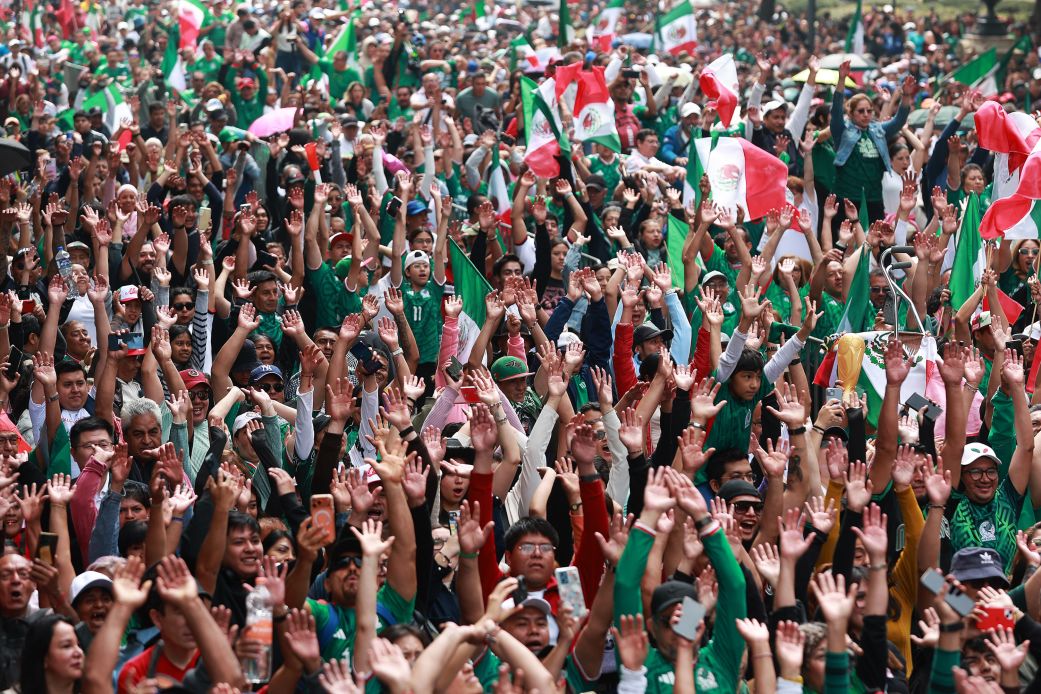
It will need no ticket scanner, no sponsor branding, no giant screen instructions and no expensive equipment. All it will take is a few dozen fans rising from their seats. Then another few dozen. And another. Before long, tens of thousands of supporters will be standing and sitting in sequence as a ripple of human movement circles the stadium.
THE MEXICAN WAVE WILL BE BACK
Unlike fan items such as drums, flares, laser pointers and the once-ubiquitous vuvuzela, which faced restrictions and criticism during major tournaments, the Mexican wave remains the ultimate unbannable expression of sporting joy. Security personnel can inspect bags, confiscate prohibited items and monitor crowd behaviour, but they cannot stop people from standing up and sitting down together. That act of collective participation has become very recognisable in the world of sports. Yet despite its name, the Mexican wave is not actually Mexican.
In one of football’s cases of mistaken identity, the phenomenon that has become synonymous with World Cups and packed stadiums was born not in Mexico but further north, in the United States and Canada, before being adopted and immortalised by Mexican football fans.
As North America prepares to host the World Cup once again, the story of the Mexican wave is coming full circle.
A DISPUTED BIRTH IN NORTH AMERICA
Long before it was known around the world as the Mexican wave, it was simply called “The Wave.” Its origins remain the subject of one of sport’s fascinating debates.
One of the strongest claims belongs to professional cheerleader and crowd entertainer Krazy George Henderson. Henderson maintains that he accidentally invented the wave during a National Hockey League game between the Colorado Rockies and Montreal Canadiens in Denver on November 15, 1979.
At the time, he was simply trying to energise spectators. What began as an attempt to engage sections of the crowd gradually evolved into coordinated movement around the arena.
Two years later, Henderson led what is often considered the first fully documented and televised version of the wave during a Major League Baseball playoff game between the Oakland Athletics and New York Yankees on October 15, 1981. But he is not the only claimant.
Just weeks later, on October 31, 1981, cheerleader Robb Weller helped orchestrate a massive side-to-side wave at the University of Washington’s Husky Stadium during a college football game. The university still proudly identifies itself as the birthplace of the modern wave.
The debate continues more than four decades later.Who performed it first? Who popularised it? Who deserves the credit? The answers depend largely on which version of history one chooses to believe.
What is far less disputed, however, is that the wave emerged in North America before eventually making its way into Mexican sporting culture. Ironically, the nation that gave the wave its global name was not the nation that invented it.
THE AZTECA EFFECT: HOW MEXICO STOLE THE SPOTLIGHT
If the wave began in North America, why does virtually everyone outside the United States and Canada call it the Mexican wave? The answer lies in one unforgettable summer.
The 1986 FIFA World Cup transformed many aspects of football culture. It introduced goals, moments and players. It also provided the perfect stage for a stadium tradition that was still relatively unknown to much of the world.
Mexican supporters had already embraced La Ola—Spanish for “The Wave”—during domestic football matches. By the time the World Cup arrived, fans were well accustomed to creating waves inside stadiums. Then came the global audience.
Inside the Estadio Azteca in Mexico City, the wave found its ultimate stage. The enormous bowl-shaped stadium, capable of holding more than 110,000 spectators at the time, amplified the effect in a way few venues on Earth could match.
During Mexico’s opening group-stage matches and later during the quarter-final clash between Mexico and West Germany, television cameras repeatedly captured enormous sections of supporters rising and falling in perfect rhythm. The effect was hypnotic.
A single movement appeared to roll endlessly around the stadium like a living organism.
Millions of viewers watching from Europe, Africa, Asia and South America had never seen anything like it. For many of them, this was their first encounter with the phenomenon.
As broadcasters attempted to describe what they were witnessing, a simple label emerged. It was happening in Mexico. Therefore, it became the Mexican wave.
The name spread rapidly through newspapers, television broadcasts and football conversations around the globe.
Within months, a local North American stadium ritual had become a worldwide sporting phenomenon associated almost exclusively with Mexico. The country had not invented the wave. But it had unquestionably perfected its presentation.
THE PHYSICS OF A STADIUM RIPPLE
What makes the Mexican wave remarkable is that it is more than just a sporting tradition. It is also a scientific curiosity. Physicists have been fascinated by how thousands of strangers can coordinate their actions without any central organiser.
In 2002, a group of Hungarian researchers published a study examining the mechanics of the wave. Their findings revealed that the phenomenon behaves remarkably like a travelling wave found in nature.
According to their research, it typically takes only 20 to 30 enthusiastic participants to initiate a successful wave. Once enough people join in, the movement becomes self-sustaining. The researchers discovered that a typical wave travels at approximately 12 metres per second, or roughly 22 seats per second. Even more remarkably, waves often move in a clockwise direction regardless of the stadium or sporting event.
The findings demonstrated that what appears to be spontaneous crowd behaviour actually follows surprisingly predictable patterns.
Every time supporters create a wave, they are unknowingly participating in a real-world demonstration of collective human behaviour. It is one of the rare moments when sport, sociology and physics collide.
A UNIVERSAL LANGUAGE OF SPORT
Today, the Mexican wave belongs to no single country. It has transcended football entirely. The wave has appeared at cricket matches in India, rugby internationals in New Zealand, baseball games in Japan, tennis tournaments, athletics championships and Olympic events. It has crossed borders, languages and cultures.
Supporters who share nothing in common except their passion for sport instinctively understand how it works. No explanation is necessary.
Unlike chants that depend on language or songs tied to specific cultures, the wave is universally understood.
A supporter in Tokyo can participate in exactly the same way as a fan in Lagos, Buenos Aires, London or Johannesburg. Few traditions in world sport possess such universal appeal. That universality is one reason why the wave has survived while countless other fan trends have disappeared.
THE PERFECT FULL-CIRCLE FOR WORLD CUP 2026
Perhaps the greatest irony of all is that the 2026 FIFA World Cup is being hosted by the very countries responsible for the wave’s complicated identity.
The United States and Canada are widely recognised as the birthplace of the wave.
Mexico is the country that transformed it into a global phenomenon.
Together, they form the three hosts of the upcoming tournament. In many ways, there could not be a more fitting setting for the wave’s return to centre stage.
Throughout the competition, supporters from 48 nations will pack stadiums stretching from Vancouver to Toronto, from Los Angeles to Dallas, and from Guadalajara to Mexico City. Many will participate in the Mexican wave without ever knowing its history.
Some will assume it began in Mexico.
Others may know about its disputed North American origins. Most will simply join in. And perhaps that is fitting.
The Mexican wave has always belonged less to inventors than to participants. Its power comes not from who created it but from how easily it unites strangers. For a few fleeting moments, thousands of people become part of a single moving rhythm.
In a sport often divided by rivalries, politics, borders and language, the wave remains one of football’s purest expressions of collective joy. So when the first Mexican wave begins rolling around a packed World Cup stadium in 2026, remember this: The world may know it as the Mexican wave. History suggests otherwise. However, without Mexico, it may never have become famous at all.
And that is why football’s most beloved crowd tradition remains one of the sport’s greatest and most enduring paradoxes.