Algeria Stand One Win Away from Exorcising the ‘Ghosts’ of Gijón

Almost 7,000 kilometres separate the Spanish coastal city of Gijón from Kansas City, where Algeria and Austria will meet once again. Forty-four years have passed since their paths first crossed on the global stage. The game has changed almost beyond recognition, but one memory has survived untouched by time.
On Sunday, June 28, Algeria have an opportunity to write a different ending against Austria. Their immediate objective is qualification for the Round of 32, but history ensures this fixture carries weight beyond the standings. It is impossible to place these two nations on opposite sides of a World Cup pitch without revisiting the events of June 1982, when Africa’s representatives became the victim of what football history remembers as the Disgrace of Gijón.
None of the Algerian players expected to feature in Kansas City were alive when it happened. Most only know the story through archive footage, books, documentaries and conversations with former internationals. Even so, it remains woven into Algeria’s football culture.
Algeria travelled to Spain in 1982 as outsiders. Drawn alongside reigning European champions West Germany, Austria and Chile, the World Cup debutants were given little chance of surviving the group.
The dismissive attitude from West Germany only added fuel to the fire. Head coach Jupp Derwall famously remarked that he would catch the first train back to Munich if his team lost to Algeria, while defender Manfred Kaltz claimed Germany could beat the North Africans “while smoking a cigar.” Those comments have been documented in Jonathan Wilson’s “The Shame of Gijon” for the Blizzard, illustrating the widespread underestimation of Algeria before the tournament.
Algeria answered in unforgettable fashion. On 16 June ‘sucker punched’ West Germany 2-1, widely considered as one of the greatest, if not the greatest World Cup upset. It was the first time an African nation had defeated European opposition at the tournament, a result that changed perceptions of African football around the world.
Their campaign, however, soon became more complicated. Austria won the next meeting 2-0 before Algeria responded with a 3-2 victory over Chile. Two wins from three matches would ordinarily have been enough to dream of the knockout rounds. Instead, Algeria’s fate rested in the hands of two opponents.
Unlike today’s World Cup, FIFA did not stage the final group fixtures simultaneously. Algeria had already completed their campaign before West Germany met Austria in Gijón. Both sides knew exactly what result would take them into the second round.
The arithmetic was simple. A West German victory by one or two goals would eliminate Algeria while sending both European teams through. A German win by three goals or more would knock Austria out. A draw or Austrian victory would eliminate West Germany. Ten minutes into the match, Horst Hrubesch headed West Germany into the lead.
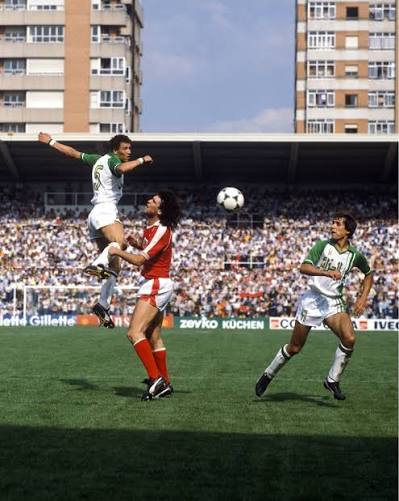
What followed was cinema, worth of box office space. For the remaining 80 minutes, both teams largely abandoned any attacking intent. Possession was exchanged without urgency, forward runs became scarce and meaningful challenges all but disappeared. Contemporary reports described a contest in which neither side appeared interested in changing the scoreline after Hrubesch’s goal.
The spectators needed little time to understand what was unfolding. Thousands of Spanish supporters waved white handkerchiefs and chanted “¡Que se besen!” (“Let them kiss!”), while Algerian fans responded by waving banknotes in protest. According to El País, Austrian television commentator Robert Seeger apologised to viewers on air, and German commentator Eberhard Stanjek reportedly stopped commentating for long periods in disgust.
When the final whistle confirmed a 1-0 German victory, Algeria’s World Cup dream had ended. The Algerian Football Federation lodged an official protest with FIFA, arguing that the match had violated the spirit of fair play. FIFA rejected the complaint, ruling that while the spectacle had damaged the tournament’s image, no written regulation had technically been broken. The fallout nevertheless changed football forever.
The controversy surrounding Gijón convinced FIFA that the existing schedule invited manipulation. Beginning with the 1986 FIFA World Cup in Mexico, every final round of group matches has kicked off simultaneously, ensuring no team can play with complete knowledge of another result. That scheduling principle remains football’s cornerstone and has since been adopted across major international competitions.
Sunday’s meeting offers football one of those rare moments where history returns to the same crossroads. The current Austrian squad bears no responsibility for what happened in Spain. Neither do Algeria’s players carry memories of that afternoon beyond what previous generations have passed down. Still, international football has always been shaped by history as much as the present.
The stakes are also straightforward. Argentina have already secured qualification, leaving Austria and Algeria to contest the second automatic place in Group J. Austria need only to avoid defeat, but Algeria must win.
This time, however, there will be no room for calculations or convenient scorelines. Both decisive group matches will kick off at exactly the same time, precisely because football learned its lesson in 1982.
For Algeria, victory would mean more than progression to the knockout rounds. It would close a chapter that has lingered for more than four decades and offer the country a measure of sporting closure against the nation linked to the World Cup’s darkest history.